Latest XK0-006 Exam Practice - XK0-006 Latest Test Simulations
Wiki Article
What's more, part of that ActualCollection XK0-006 dumps now are free: https://drive.google.com/open?id=1UCrf8Wrge6lPXsT8kGYtpDQ3ugbbV3_c
The ActualCollection experts regularly add these changes in the ActualCollection XK0-006 exam dumps questions so that you do not miss a single XK0-006 exam update. With the purchasing of ActualCollection XK0-006 exam practice questions you get an opportunity to get free ActualCollection XK0-006 Exam Dumps questions updates for up to 1 year from the date of ActualCollection XK0-006 exam questions purchase.
CompTIA XK0-006 Exam Syllabus Topics:
| Topic | Details |
|---|---|
| Topic 1 |
|
| Topic 2 |
|
| Topic 3 |
|
| Topic 4 |
|
>> Latest XK0-006 Exam Practice <<
XK0-006 Latest Test Simulations, Latest XK0-006 Exam Materials
In the era of rapid development in the IT industry, we have to look at those IT people with new eyes. They use their high-end technology to create many convenient place for us. And save a lot of manpower and material resources for the state and enterprises. And even reached unimaginable effect. Of course, their income must be very high. Do you want to be the kind of person? Do you envy them? Or you are also IT person, but you do not get this kind of success. Do not worry, ActualCollection's CompTIA XK0-006 Exam Material can help you to get what you want. To select ActualCollection is equivalent to choose a success.
CompTIA Linux+ Certification Exam Sample Questions (Q53-Q58):
NEW QUESTION # 53
Which of the following describes what Ansible is used for in the context of IT infrastructure?
- A. Database management
- B. Configuration management
- C. Asset management
- D. Process management
Answer: B
Explanation:
The correct answer is B. Configuration management because Ansible is primarily designed as an automation and configuration management tool used to manage IT infrastructure efficiently. Within Linux environments, Ansible allows system administrators to define the desired state of systems using human-readable YAML- based playbooks. These playbooks automate tasks such as software installation, system updates, service configuration, and deployment processes across multiple machines.
Ansible operates in an agentless architecture, meaning it does not require additional software to be installed on managed nodes. Instead, it uses standard protocols such as SSH to communicate with remote systems. This makes it lightweight and easy to deploy compared to other configuration management tools. In the Linux+ context, understanding automation tools like Ansible is essential for maintaining consistency across systems, reducing manual configuration errors, and improving operational efficiency.
Option A (Database management) is incorrect because Ansible is not specifically designed to manage or administer databases, although it can automate database-related tasks. Option C (Process management) is incorrect because process management refers to controlling running processes (e.g., using commands like ps, kill, or top), which is not Ansible's primary function. Option D (Asset management) is also incorrect because asset management involves tracking hardware and software inventory, which is outside the scope of Ansible's core capabilities.
In modern Linux system administration, tools like Ansible are widely used for orchestration and configuration management, enabling administrators to automate repetitive tasks, enforce system consistency, and scale infrastructure management effectively.
NEW QUESTION # 54
A user states that an NFS share Is reporting random disconnections. The systems administrator obtains the following information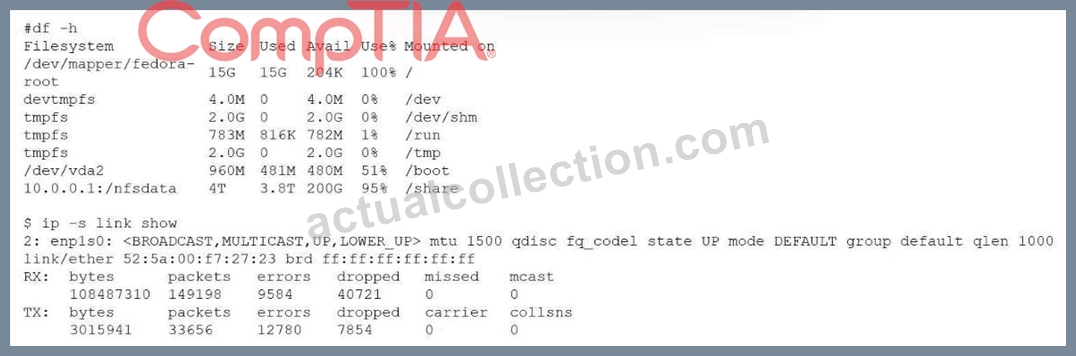
Which of the following best explains the symptoms that are being reported?
- A. The filesystem is nearly full and is reporting errors.
- B. The mount point is incorrect for the NFS share.
- C. The interface is reporting a high number of errors and dropped packets.
- D. The IP address of the NFS share is incorrect.
Answer: C
Explanation:
This issue is best analyzed using a layered troubleshooting approach, as recommended in the Troubleshooting domain of CompTIA Linux+ V8. The reported symptom is intermittent or random disconnections from an NFS share, which commonly indicates a network reliability issue rather than a configuration or filesystem problem.
The most critical evidence comes from the output of ip -s link show. The network interface enp1s0 is reporting significant numbers of errors and dropped packets on both the receive (RX) and transmit (TX) paths. High packet loss at the network interface level directly affects protocols like NFS, which rely on stable, continuous TCP/IP communication. When packets are dropped or corrupted, NFS clients may experience timeouts, retransmissions, and apparent disconnections.
Although the df -h output shows that the NFS filesystem is 95% full, this alone does not typically cause random disconnections. A nearly full filesystem may lead to write failures or performance degradation, but it does not explain intermittent connectivity loss. Linux+ V8 documentation notes that filesystem capacity issues usually present as I/O errors, not transport-layer disconnects.
Options A and B can also be ruled out. If the mount point or IP address were incorrect, the NFS share would fail consistently rather than intermittently. The fact that the share is mounted and accessible confirms that the mount configuration and IP addressing are correct.
Linux+ V8 emphasizes that NFS performance and reliability are highly sensitive to network quality. Packet errors, drops, faulty NICs, cabling issues, duplex mismatches, or driver problems commonly result in unstable NFS behavior.
Therefore, the best explanation for the reported random disconnections is D. The interface is reporting a high number of errors and dropped packets.
NEW QUESTION # 55
An administrator needs to remove the directory /home/user1/dataand all of its contents.
Which of the following commands should the administrator use?
- A. cut -d /home/user1/data
- B. ln -d /home/user1/data
- C. rmdir -p /home/user1/data
- D. rm -r /home/user1/data
Answer: D
Explanation:
The rm -r command recursively removes a directory and all of its contents (files and subdirectories), which is required for deleting /home/user1/data.
NEW QUESTION # 56
Users report that a Linux system is unresponsive and simple commands take too long to complete. The Linux administrator logs in to the system and sees the following: Output 1:
10:06:29 up 235 day, 19:23, 2 users, load average: 8.71, 8.24, 7.71
Which of the following is the system experiencing?
- A. High CPU load
- B. High uptime
- C. High latency
- D. High I/O wait times
Answer: A
Explanation:
This scenario is a classic performance troubleshooting case covered under the Troubleshooting domain of the CompTIA Linux+ V8 objectives. The key indicators to analyze are the load average values and the CPU utilization statistics.
The uptime command shows load averages of 8.71, 8.24, and 7.71 over the 1-, 5-, and 15-minute intervals.
Load average represents the average number of processes that are either running on the CPU or waiting to run. On a system with 4 CPU cores, a healthy load average would typically be close to or below 4. Load averages consistently near or above 8 indicate that there are significantly more runnable processes than available CPU resources, causing processes to wait and resulting in poor system responsiveness.
The CPU output further confirms this condition. The %idle value is 0, meaning the CPU has no idle time available. The majority of CPU time is spent in user space (65.88%) and system/kernel space (20.54%), indicating heavy computational and kernel activity. While %iowait is present at 5.65%, it is not high enough to suggest that disk I/O is the primary bottleneck.
Option C, high CPU load, best explains the symptoms. High CPU load causes commands to execute slowly because processes are competing for limited CPU time. This directly matches the observed behavior of the system being unresponsive.
The other options are incorrect. High uptime simply indicates how long the system has been running and does not cause performance issues by itself. High latency is a general term and not a specific diagnosis shown by the metrics provided. High I/O wait times would require a significantly higher %iowait value.
According to Linux+ V8 documentation, correlating load averages with CPU core count and utilization is essential for accurate performance diagnosis. Therefore, the correct answer is C. High CPU load.
NEW QUESTION # 57
Which of the following describes the method of consolidating system events to a single location?
- A. Health checks
- B. Log aggregation
- C. Webhooks
- D. Threshold monitoring
Answer: B
Explanation:
Consolidating system events from multiple sources into a single, centralized location is a key concept in Linux system administration and is explicitly covered under logging and monitoring topics in the CompTIA Linux+ V8 objectives. This method is known as log aggregation, making option A the correct answer.
Log aggregation refers to the practice of collecting logs generated by operating systems, services, applications, and network devices and storing them in a centralized repository. In Linux environments, logs may originate from systemd-journald, syslog, application-specific log files, containers, and cloud-based workloads. Aggregating these logs allows administrators to analyze events more efficiently, correlate issues across systems, and improve troubleshooting, auditing, and security monitoring.
Linux+ V8 documentation emphasizes centralized logging as a best practice in environments with multiple servers. Without log aggregation, administrators would need to log in to each system individually to inspect logs, which is inefficient and error-prone. Centralized solutions such as syslog servers, ELK/EFK stacks, and SIEM platforms enable real-time analysis, long-term retention, and alerting based on log data.
The other options do not describe log consolidation. Health checks are used to verify whether services or systems are operational but do not collect or store event data. Webhooks are HTTP-based callbacks used for event-driven automation and notifications, not for storing logs. Threshold monitoring involves generating alerts when metrics exceed defined limits, such as CPU or memory usage, but it does not centralize system event records.
Linux+ V8 stresses that effective log aggregation improves incident response, supports compliance requirements, and enhances system visibility. It is especially important for detecting security incidents, diagnosing failures, and performing root-cause analysis across distributed systems.
NEW QUESTION # 58
......
Almost all of our customers have passed the XK0-006 exam as well as getting the related certification easily with the help of our XK0-006 exam torrent, we strongly believe that it is impossible for you to be the exception. So choosing our XK0-006 exam question actually means that you will have more opportunities to get promotion in the near future, What's more, when you have shown your talent with XK0-006 Certification in relating field, naturally, you will have the chance to enlarge your friends circle with a lot of distinguished persons who may influence you career life profoundly.
XK0-006 Latest Test Simulations: https://www.actualcollection.com/XK0-006-exam-questions.html
- Exam XK0-006 Online ???? New XK0-006 Test Materials ???? XK0-006 New copyright Questions ???? Search for ⇛ XK0-006 ⇚ on ⮆ www.testkingpass.com ⮄ immediately to obtain a free download ????XK0-006 New copyright Questions
- Exam XK0-006 Questions Fee ???? Exam Vce XK0-006 Free ⚜ Exam Vce XK0-006 Free ???? Search for ⏩ XK0-006 ⏪ and obtain a free download on “ www.pdfvce.com ” ????XK0-006 New copyright Questions
- Pass Guaranteed Quiz 2026 High-quality CompTIA Latest XK0-006 Exam Practice ???? Search for { XK0-006 } and download it for free on 「 www.dumpsquestion.com 」 website ????Valid Test XK0-006 Bootcamp
- 100% Free XK0-006 – 100% Free Latest Exam Practice | the Best CompTIA Linux+ Certification Exam Latest Test Simulations ???? Immediately open 【 www.pdfvce.com 】 and search for ▛ XK0-006 ▟ to obtain a free download ⏳Valid XK0-006 Test Discount
- Pass Guaranteed Quiz 2026 High-quality CompTIA Latest XK0-006 Exam Practice ???? Enter ➽ www.easy4engine.com ???? and search for ☀ XK0-006 ️☀️ to download for free ????Exam XK0-006 Questions Fee
- 100% Pass 2026 CompTIA Professional Latest XK0-006 Exam Practice ⚒ Open ⮆ www.pdfvce.com ⮄ and search for ▶ XK0-006 ◀ to download exam materials for free ????Exam XK0-006 Online
- Free PDF Quiz CompTIA - XK0-006 –Valid Latest Exam Practice ↔ Search on 【 www.troytecdumps.com 】 for ⏩ XK0-006 ⏪ to obtain exam materials for free download ????XK0-006 Test Dump
- Using Latest XK0-006 Exam Practice - No Worry About CompTIA Linux+ Certification Exam ⚫ Search for ➥ XK0-006 ???? and easily obtain a free download on ⇛ www.pdfvce.com ⇚ ????Sample XK0-006 Questions Answers
- Study XK0-006 Material ???? XK0-006 New copyright Questions ???? Valid XK0-006 Exam Prep ???? Simply search for [ XK0-006 ] for free download on ⮆ www.vceengine.com ⮄ ⏺New XK0-006 copyright Pdf
- 100% Free XK0-006 – 100% Free Latest Exam Practice | the Best CompTIA Linux+ Certification Exam Latest Test Simulations ✔ Open ⮆ www.pdfvce.com ⮄ enter ( XK0-006 ) and obtain a free download ????New XK0-006 copyright Pdf
- New XK0-006 Test Preparation ???? XK0-006 Excellect Pass Rate ???? Valid XK0-006 Test Discount ???? Search for ▷ XK0-006 ◁ and obtain a free download on ✔ www.pdfdumps.com ️✔️ ????XK0-006 Latest Exam Tips
- jakubonie382786.birderswiki.com, seek-directory.com, mayagcaf672074.blogthisbiz.com, aronpnoh657025.blogsumer.com, aishaipht689311.wikibuysell.com, keiranzixu533968.wikinarration.com, aprildpob522925.cosmicwiki.com, www.slideshare.net, gerardofzw092733.blogitright.com, mysterybookmarks.com, Disposable vapes
P.S. Free 2026 CompTIA XK0-006 dumps are available on Google Drive shared by ActualCollection: https://drive.google.com/open?id=1UCrf8Wrge6lPXsT8kGYtpDQ3ugbbV3_c
Report this wiki page